How to Use a Digital Tire Inflator and Set Your Car’s Tire Pressure Right in Egypt’s Heat


Winter is coming, the mornings have turned cold, and every year around this time we hear the same thing: “My tire went down on its own, with no nail!” Most likely there’s no nail at all: the air inside the tire is affected by temperature, so when the weather cools the pressure drops, and when summer and the hot asphalt arrive the pressure rises. That’s why a small digital tire inflator in the trunk lets you check and adjust the pressure yourself in front of your house in minutes, instead of waiting until you pass by a gas station.
We see this every season: people who adjust their pressure once when the weather changes have peace of mind, while those who wait until the steering feels heavy end up paying for tires later. In this article we’ll walk you step by step through how to use a tire inflator properly, how to read the numbers in cold and hot weather, and when the inflator isn’t enough and you need to visit a tire shop.
The Short Version Before the Details
- Measure when the tires are cold: before you drive, or after the car has been parked for about 3 hours.
- Set the pressure to the number on the driver’s door sticker, not the number on the tire sidewall.
- Don’t let air out of a hot tire; wait for it to cool down and measure again.
- Check at least once a month and before any trip, and don’t forget the spare.
Where Do You Find the Right Tire Pressure for Your Car?
The first mistake is asking someone “What pressure do you use?” and copying them. Every car has a different pressure depending on its weight and tire size. You’ll find the right number:
- On a sticker on the inside edge of the driver’s door.
- Inside the fuel filler flap on many cars.
- In the car’s owner’s manual.
The number written on the tire sidewall itself is the maximum pressure the tire can handle, not the pressure you should drive with. Sometimes the recommended pressure for the front wheels differs from the rear, and some cars have a separate number for when they’re fully loaded, like a family trip to the North Coast or Hurghada.
How to Use a Digital Tire Inflator Step by Step
- Measure when the tires are cold: the best time is in the morning before you drive.
- Start the car if the inflator plugs into the cigarette lighter: so it gets enough power and doesn’t drain the battery while the engine is off.
- Remove the valve cap and attach the hose securely: if you hear air escaping, the connection isn’t sealed properly. Screw it on or close the clamp until the sound stops.
- Read the current pressure: the screen will show you the number before you start.
- Set the target pressure: choose the same unit shown on the sticker (PSI or BAR) and enter the number.
- Turn it on and let it work: an inflator with auto shut-off will stop on its own when it reaches the target.
- Remove the hose quickly and put the valve cap back on: the cap protects the valve from dust, and check the spare tire too.

Tire Inflators Between Winter Cold and Summer Heat: Why Does the Pressure Change?
Air expands with heat and contracts with cold. A tire you set in the morning will read higher in the afternoon or after a drive, and Pirelli says the heat after driving or parking in the sun can raise the pressure by a few PSI. That’s why:
- Don’t let air out of a hot tire: Michelin warns that if you reduce the pressure while the tire is hot, it will be genuinely underinflated once it cools down.
- Make a fair comparison: always measure with cold tires, so you can tell if one tire is losing air faster than the others.
- At the first cold snap of winter: do a quick check, because pressure drops in the cold, and tires also lose air naturally over time.
- Before a summer trip: adjust the pressure while you’re still at home and the tires are cold, especially if the car is fully loaded.
Tire Losing Air Fast: When Is a Tire Inflator Not Enough?
An inflator solves the pressure problem, but it doesn’t repair the tire. Go straight to a tire shop if:
- Every few days you find the same tire lower than the others.
- You see a nail, a cut or a bulge in the tire sidewall.
- The valve itself leaks even after you close the cap.
- The tire went completely flat and you drove on it; the sidewall may have been damaged.
In these cases, use the inflator to get safely to the nearest tire shop, not as a permanent fix.
Choose Your Inflator Based on How You Drive
- To keep in the trunk at all times: 12V digital car tire inflator that runs from the cigarette lighter with a 3 m cable (YESIDO VC05), priced at 1,799 EGP.
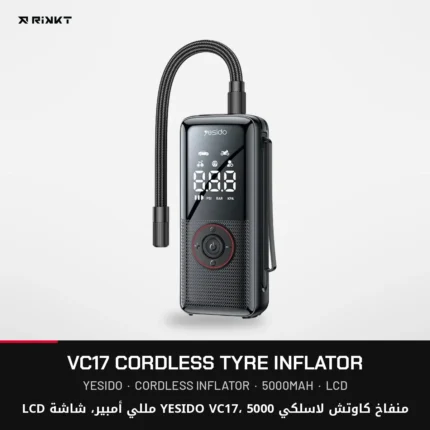
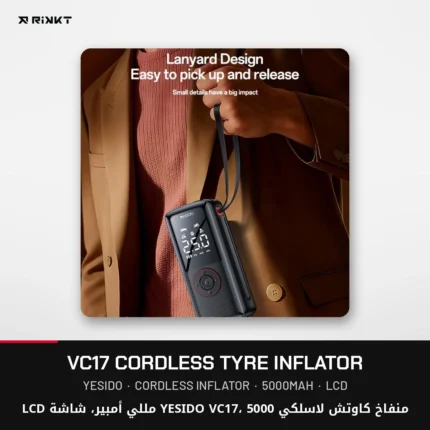
- For quick checks in front of the house: Cordless tire inflator with LCD screen and 5000mAh battery (YESIDO VC17), priced at 1,999 EGP.
- For night-time emergencies: 3-in-1 smart inflator with power bank and LED flashlight (RAVPower RP-PB1233), priced at 4,080 EGP.
- For cars, bikes and balls: Portable air pump with an accurate LCD screen and multiple modes (BOROFONE FC1), priced at 1,765 EGP.
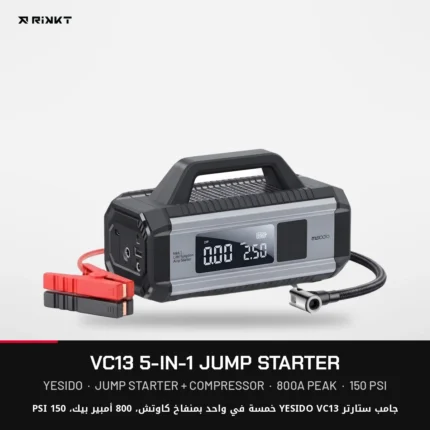
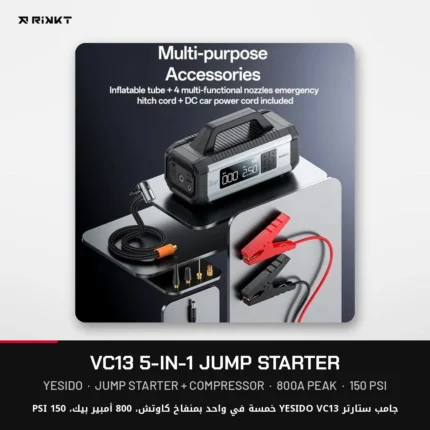
- For road trips and batteries that die: 5-in-1 jump starter with tire inflator (YESIDO VC13), priced at 5,299 EGP.

Pay cash on delivery or via InstaPay, with delivery all over Egypt in 2 to 5 working days. You can inspect your order on delivery, and you collect points on every order.
Tire Inflator or Air Compressor? (Tire Inflator vs Air Compressor)
| Comparison | Portable tire inflator | Large air compressor |
|---|---|---|
| Purpose | Car, motorcycle and bicycle tires | Workshop air tools and heavy-duty work |
| Size | Small and fits in the trunk | Large and needs mains power |
| Speed | Suitable for pressure top-ups and emergencies | Much faster |
| Ease of use | Screen and auto shut-off on most models | Needs more experience |
For the average car owner, a portable inflator is what will actually serve you, because it’s with you wherever you go. If your car sits for days or you travel long distances, an inflator with a built-in jump starter like the YESIDO VC13 makes sense; in the city with a healthy battery, a cordless or cigarette-lighter inflator is enough.
Things to Keep with Your Tire Inflator in the Trunk
Keep gloves and a cloth with the inflator, along with your tools, the jack, and a spare tire with its pressure set too. If your inflator is cordless, set a reminder on your phone to charge it at the start of every month along with your pressure check, because the worst thing is pulling it out in an emergency and finding it dead.

Frequently Asked Questions
Why do my tires read lower in the morning in winter?
Because air contracts in the cold. Set it to the number on the sticker while the tire is cold; that’s the correct number.
Why does my inflator show one number and the gas station another?
The tire may have been hot one time and cold the other, or the two gauges differ. Rely on one consistent measurement with the same inflator and cold tires.
The inflator leaks air at the valve. What should I do?
Usually the connector isn’t screwed on all the way or it’s at an angle. Remove it and reattach it straight; if the problem is the valve itself, it needs to be replaced at a tire shop.
Can I run a cigarette-lighter inflator with the car turned off?
It’s better to start the car so you don’t drain the battery, especially if you’re inflating more than one tire.
Does a tire inflator work for motorcycles?
Yes, as long as it’s a standard valve, but get the right pressure for your motorcycle from its owner’s manual.
See all types of inflators in the tire inflators and air compressors section at Rikkt, and choose the one that suits your car and how you use it.
Sources
- Michelin – Measuring pressure with cold tires, not letting air out of hot tires, and pressure when loaded
- Michelin – What a cold tire means, how often to check, including the spare
- Pirelli – How heat affects tire pressure and where the recommended number is written